 Office System

CAAI Newsroom
"Zhi Xing China" Forum Episode 11: AI Education Ethics - Interpreting "AI Education Ethics: A Reference
On May 12, 2026, "AI Education Ethics: A Reference Framework" was officially released at the 2026 World Digital Education Conference in Hangzhou, Zhejiang Province. The framework provides systematic ethical guidelines and behavioral guidance for AI applications across educational stages and types, including basic education, higher education, and vocational education. It establishes the core concepts of "human-centered agency, collaborative symbiosis, context-appropriate beneficence, and classified governance," clarifies three types of risks in AI education applications along with principles of responsibility attribution, and sets forth ethical behavioral norms for educators, learners, and educational institutions in basic, higher, and vocational education. Additionally, the framework defines three types of behavioral boundaries - "prohibited access, limited use, and encouraged use" - along with their dynamic adjustment mechanisms, safeguarding educational baselines, guiding human-machine collaboration, and stimulating innovative potential. The framework aims to further clarify the manner, boundaries, and value order governing AI's integration into education, striving to establish a clear normative foundation between technological development and the mission of education, and to ensure that the benefits of AI development are more equitably shared among all learners.
On June 3, 2026, the 11th episode of the "Zhi Xing China" series forum was successfully held, co-sponsored by the Chinese Association for Artificial Intelligence (CAAI) and the China Computer Federation (CCF), organized by the CAAI Educational Activities Committee and the CCF Professional Ethics and Public Policy Committee, and co-organized by the National Key Research Base for Textbook Construction (Higher Education AI Textbook Research) and the Zhejiang University AI Education and Teaching Research Center. The forum was themed "AI Education Ethics: Self-Fulfillment and World-Making - Interpreting 'AI Education Ethics: A Reference Framework'" and invited experts and scholars to provide in-depth interpretations of AI education ethics, analyzing the unique interplay of technological and social attributes inherent in AI.
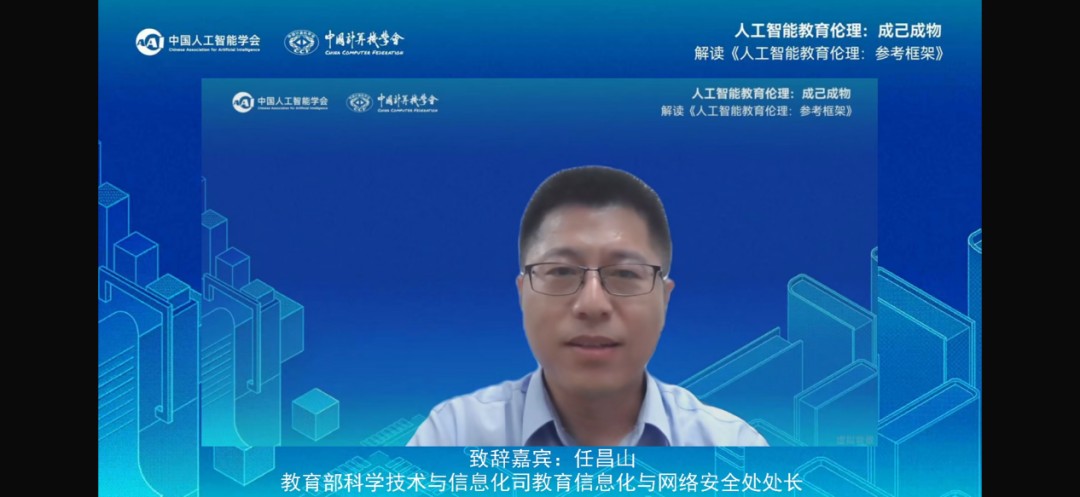
In his opening remarks, Ren Changshan, Director of the Education Informatization and Cybersecurity Division of the Department of Science, Technology, and Information Technology of the Ministry of Education, emphasized that the deep integration of AI into the education sector is not merely a matter of technological application but rather a systemic transformation affecting teaching, research paradigms, and governance models. The Ministry of Education attaches great importance to AI's profound impact on education, deeply implements the AI Empowers Education initiative, and comprehensively promotes the deep integration of AI with education. The Ministry continues to implement the AI Large Model Application Demonstration Action in the education system, promoting the development and application of vertical models across academic disciplines and specialized AI large models for education. He noted that the release of "AI Education Ethics: A Reference Framework" seeks to establish a clear normative foundation between technological development and the mission of education, ensuring that the benefits of AI development are more equitably shared among all learners. He expressed hope that this forum would serve as an opportunity to build consensus, deepen cooperation, and jointly promote the effective implementation of AI in education, making new and greater contributions to building a new ecosystem for intelligent education, serving the construction of an education powerhouse, and leading and supporting educational modernization.
Add:No. 10, Xitucheng Road, Haidian District, Beijing Postal Code:100876
Copyright © 2026 Chinese Association for Artificial Intelligence 互联网ICP备案:京ICP备06029423号-1  京公网安备11010802045678号
Technical support:中科服 18911522009
【本网站翻译内容来源于AI】