 Office System

CAAI Newsroom
CAAI Campus Outreach Held at Beijing Jiaotong University
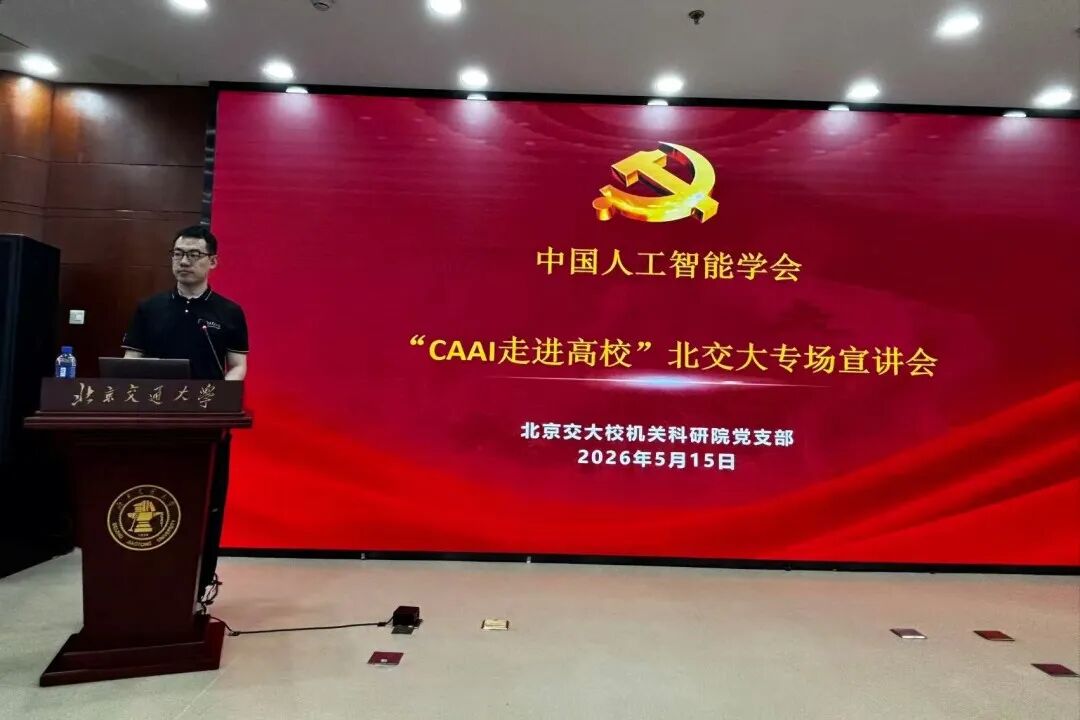
On the afternoon of May 15, the "CAAI Campus Outreach" series event at Beijing Jiaotong University was successfully held, hosted by the Chinese Association for Artificial Intelligence (CAAI). The meeting was chaired by Yang Wenxu from the Achievement Comprehensive Office of the Beijing Jiaotong University Science and Technology Research Institute. Attendees included CAAI Deputy Secretary-General Chen Wenbai, Liu Yanna (Secretary of the Science and Technology Exchange and International Cooperation Office), Chen Guang (Secretary of the Awards and Achievements Office), Yang Heng (Deputy Director of the Achievement Transformation Office, Beijing Jiaotong University Science and Technology Research Institute), Professor Zhu Zhenfeng from the School of Computer Science and Technology, and Liu Rong from the Achievement Comprehensive Office. Faculty and student representatives from Beijing Jiaotong University's School of Automation and Intelligence, School of Electronic and Information Engineering, and School of Computer Science and Technology also participated.
Deputy Director Yang Heng delivered a welcome speech. He reviewed the longstanding close collaboration between the university and CAAI and highlighted the university's outstanding achievements in recent Wu Wenjun AI Science and Technology Award selections: the project led by Professor Zhu Zhenfeng won the 13th Science and Technology Progress Award (Second Prize), and the project involving Professor He Zhihai won the 2024 Technological Invention Award (First Prize). Since 2021, the university has been awarded a total of 10 CAAI academic fund projects, with total funding of 1.57 million RMB.
Deputy Secretary-General Chen Wenbai provided a systematic and in-depth interpretation of the Wu Wenjun AI Science and Technology Award, covering three dimensions: application policies, evaluation criteria, and key points for writing application materials. He addressed common pitfalls in past evaluations that led to automatic disqualification, such as innovations being too engineering-oriented, unclear contributions, and non-standard language, offering targeted suggestions for avoidance and writing techniques. Additionally, he focused on introducing core CAAI services including scientific and technological achievement evaluation (achievement appraisal), academic funds, and computing power support programs, providing clear guidance for faculty to efficiently access CAAI resources and enhance the impact of their achievements.
Add:No. 10, Xitucheng Road, Haidian District, Beijing Postal Code:100876
Copyright © 2026 Chinese Association for Artificial Intelligence 互联网ICP备案:京ICP备06029423号-1  京公网安备11010802045678号
Technical support:中科服 010-83869879
【本网站翻译内容来源于AI】