 Office System

CAAI Newsroom
CAAI -- Shandong University of Science and Technology
On December 29, 2019, the activity "CAAI into universities ", organized by bioinformatics and artificial life committee of China Association for Artificial Intelligence (CAAI), came to Qingdao campus of Shandong University of Science and Technology.
Xinqi GONG, CAAI senior member and researcher of institute of mathematical sciences, Renmin university of China, Hongmin CAI, professor of school of computer science and engineering, South China university of technology, Kang NING, professor of college of life science and technology, Huazhong University of Science and Technology, Fa ZHANG, research in institute of computing technology, Chinese Academy of Sciences, Shiwei SUN, associate research in institute of computing technology, Chinese Academy of Sciences and professor Xuefeng CUI from Shandong University delivered an academic feast about the intersection of deep learning and bioinformatics. Nearly 100 teachers and students from Shandong University (located in weihai), Qufu Normal University and Qingdao University of Technology attended the lecture. Dr. Xinzeng WANG from school of mathematics, Shandong University of Science and Technology, presided over the report.
Xinqi GONG presented a report entitled "Computational Prediction of the Interaction Topologies and Complexes of Multi-body Super-large Proteins". He introduced his research team’s calculation and prediction on multibody system protein interactions, explored the multi-body geometric characteristics of protein interactions, found new rules of interfacial amino acid pairing, developed machine learning algorithm to predict interactions between two-body, three-body and four-body protein, and constructed a deep learning framework for predicting amino acid distance matrix from monomer proteins.
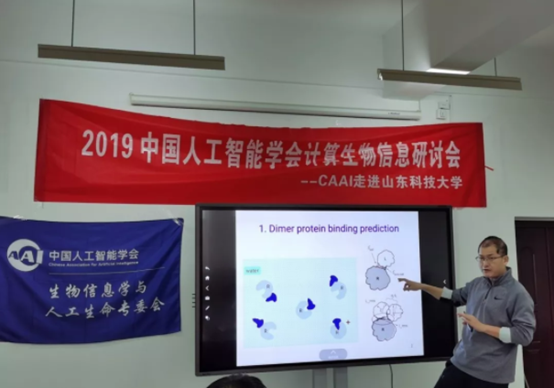
A photo of Xinqi GONG making his report
Hongmin CAI delivered a report titled "From genomics to radiomics to understand the heterogeneity between genotype and phenotype". His quantitative research is different from macro image to micro gene level to get the vertical information of biological systems, which showed that vertical information of biological systems can be obtained by quantitative research from macro images to different levels of micro genes, and the horizontal multi-modal and different scale information can also be obtained based on different observation tools at the same level. In this way, a variety of data including macro image and micro gene were generated, and it was discussed that different data integration analysis could compensate for missing or wrong information in single source data, thus reducing the high false positives commonly seen in single omics analysis.
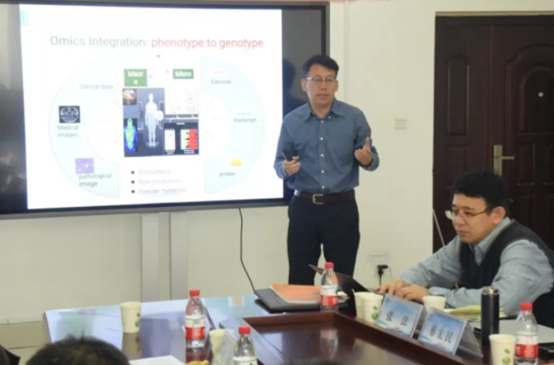
A photo of Hongmin CAI making his report
Kang NING’s report entitled "Big data mining in the microbiome: a new approach to protein structure and function prediction", explores new applications of marine genomes in protein structure and function prediction. By processing 1.3 terabytes of high-quality data from the Tara marine data, 97 million non-redundant genes were obtained that matched 5,721 Pfam families lacking experimental structure, of which 2,801 had at least one member homologous to Marine metagenomics.
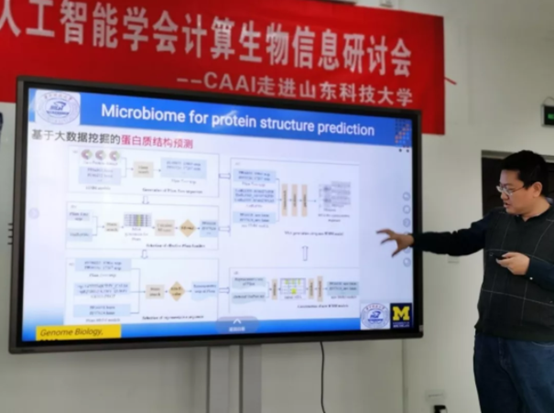
A photo of Kang NING making his report
In Fa ZHANG’s report entitled "pathological image classification and attempt in the tumor markers to predict", he introduced the biggest breast cancer pathology image sample library, and deep learning classification algorithms based on the sample library of two breast cancer pathology image: 1) breast cancer pathology image classification algorithm based on mixed deep web; 2) pathological image classification algorithm based on multi-mode fusion. In addition, he presented the preliminary results of a pathology-based cancer marker (TMB).
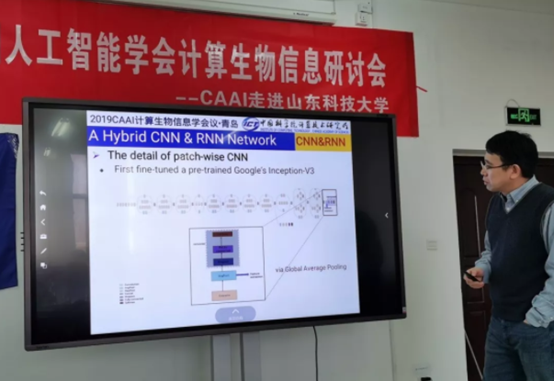
A photo of researcher Fa ZHANG making his report
Shiwei SUN delivered a report entitled "Toward Automated Identification of Glycan Branching Patterns Using Multistage Mass Spectrometry with Intelligent we Selection". Centered on the Glycan activity and the details of the structure, he studied the main method of Multistage Mass Spectrometry identification of polysaccharide structure. His research method includes two key elements, one is an empirical model for calculating the 'probability' of the candidate glycan, and the other is a statistical model for calculating the 'distinguishing ability' of the fragment ions. With aims to choose the structure information of the largest peak as the next phase scanning of precursors, he built a wisdom precursors selection strategy to guide the multistage mass spectrometry experiments based on the two elements mentioned above.
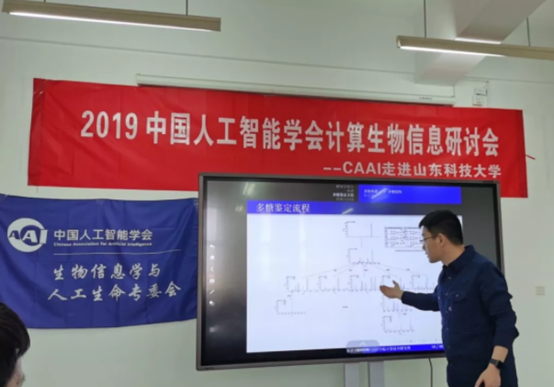
A photo of associate researcher Shiwei SUN making his report
Xuefeng CUI made a report entitled "Finding Remote Homologous Proteins: alline-based, allination-free and cross-modal Methods" and proposed three new methods to find Remote Homologous Proteins with different targets: PROSTA algorithm, ContactLib algorithm and CMsearch algorithm. Studies have shown that these methods can not only improve the accuracy of finding homologous proteins, but also improve the accuracy of predicting protein structures. In addition, this method is pioneered to find structural similarities between functionally related protein-dna complex pairs.
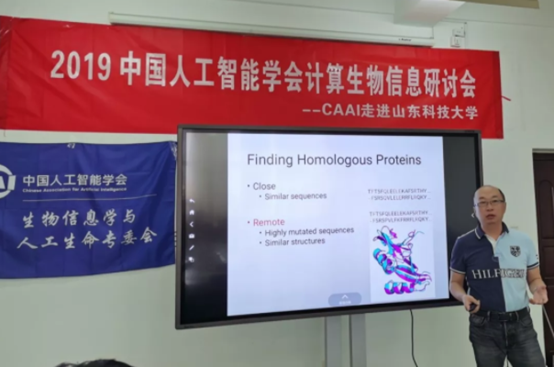
A photo of Xuefeng CUI making his report
After the successful conclusion of the event, the experts and students who participated in the seminar took a group photo.
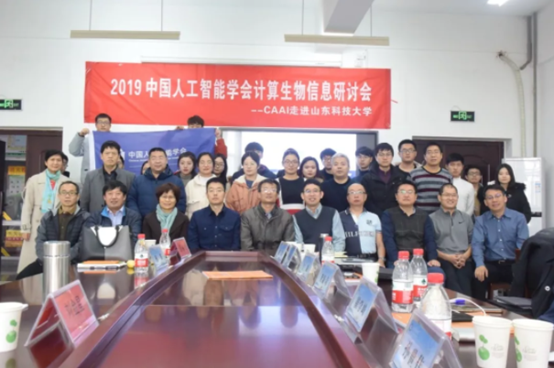
A group photo of the experts and students participated in the seminar
Add:No. 10, Xitucheng Road, Haidian District, Beijing Postal Code:100876
Copyright © 2026 Chinese Association for Artificial Intelligence 互联网ICP备案:京ICP备06029423号-1  京公网安备11010802045678号
Technical support:中科服 010-83869879
【本网站翻译内容来源于AI】