 Office System

CAAI Newsroom
CAAI First Class AI Journal Construction Seminar Held in Shenzhen
On January 4, 2020, sponsored by China artificial intelligence society and jointly organized by Chongqing University of science and technology and intelligent robot Open Laboratory of Peking University, CAAI transactions on intelligence technology, a first-class AI journal construction seminar and Journal of CAAI, the second and first editorial board of which was held in Shenzhen.
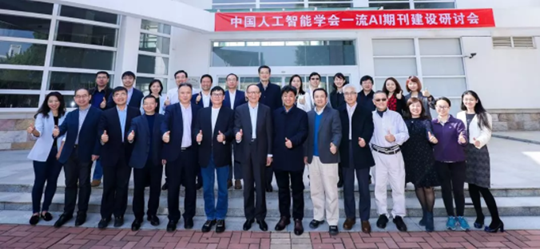
Director of journal editorial board, chairman of CAAI, academician Dai Qionghai of Chinese Academy of Engineering. Editors in chief of the journal, honorary president of CAAI Academician Li Deyi of Chinese Academy of engineering, vice president Tian Bo of Chongqing University of technology. Deputy directors of Journal Editorial Board: Professor Shi Xiaohui of Chongqing University of science and technology, editor and reviewer Peng Xi, President of Journal Agency of Chongqing University of science and technology.Associate editors in chief: Professor Xu Xin, National Defense University of science and technology, Professor Xu Yong, Harbin University of technology, Professor Zhang Xiaochuan, Chongqing University of technology.Editorial board members: academician Ge Shuzhi, Singapore Academy of engineering, Professor Sun Fuchun, Tsinghua University (vice president of CAAI), Professor Liu Yunhui, Chinese University of Hong Kong, Professor Miao daiqian, Tongji University, Professor Wang Wenmin, Macao University of science and technology, Professor Chen Yinong, Arizona State University, Professor Gong Maoguo, Xi'an University of Electronic Science and technology, Associate Professor Yang Wenming, Tsinghua University Yu Ning, associate professor, Qing University of science and technology, Xu Feng, associate professor of Tsinghua University (Deputy Secretary General of CAAI), Fang Lu, associate professor of Tsinghua University, He Wen, Ph.D., Ding runwei, Peking University, Jiang Wanyue, Ph.D., Qingdao University, and Wang Baihua, manager of IET. He Liu, director of the editorial department, and Xu Jiayi, editor of the journal attended the Editorial Committee. Liu Hong, executive editor of the journal, vice president of CAAI and professor of Peking University, presided over the meeting.
Academician Li Deyi, director of the first editorial board, awarded the letter of appointment to academician Dai Qionghai, as the director of the second editorial board. And Dai Qionghai awarded the letter of appointment to Li Deyi, the second editor in chief, Professor Liu Hong, the executive editor, and academician Ge Shuzhi, the representative of the core editorial board.
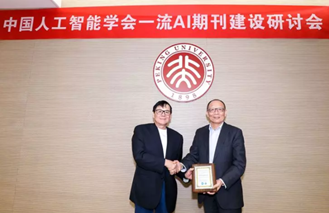
Academician Li Deyi issues letter of appointment to academician Dai Qionghai
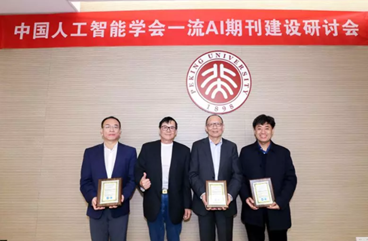
Academician Dai Qionghai awarded letter of appointment to Academician Li Deyi, Professor Liu Hong and academician Ge Shuzhi
Academician Dai Qionghai affirmed the rapid development of the journal and the achievements made at present. He highly appreciated the high attention and support of the leaders of Chongqing University of science and technology. He mentioned that to become a world-class journal, we must do a good job of "walking out, inviting in". He believes that the current "inviting in" work of journals has been relatively excellent, and a high degree of internationalization of editorial board members and authors has been achieved, but " walking out" needs to be strengthened. Efforts should be made to win the support of the CAST, and excellent scientists should be encouraged to write papers at homeland. Finally, he hopes that under the leadership of the new editorial team, journals can achieve better results.
Academician Li Deyi pointed out that we should respond to the call of the times, move forward to the first-class journals, and point out the direction for the development of journals from three aspects of "situation, objectives and measures". He believes that running journals is an "elegant, slow and wonderful" process. The editorial board should make joint efforts to build the only English journal of the Institute into a first-class AI journal with its own characteristics, and further improve the global popularity of the journal by using a variety of artificial intelligence means.

Academician Dai Qionghai (left), Academician Li Deyi (right)
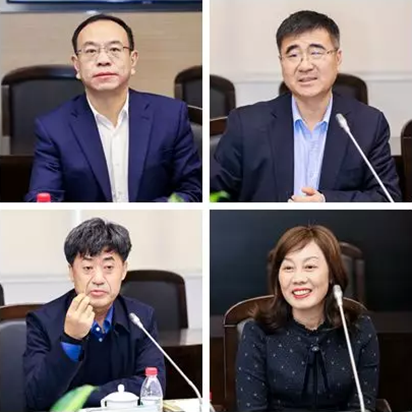
Professor Liu Hong (top left), Professor Sun Fuchun (top right)
Academician Ge Shuzhi (bottom left), President Peng Xi (bottom right)
Professor Liu Hong presided over the meeting and led the guests to watch the publicity video of CAAI transactions on intelligence technology.
Peng Xi, deputy director of the editorial board of the journal and President of the journal society of Chongqing University of science and technology, reviewed the hard past, the fruitful present and the confident future of the journal together with the guests from four aspects, such as the way, unforgettable memory, seeking support and several suggestions.
Academician Ge Shuzhi thinks that the operation mechanism of the Journal Agency has a great advantage in running the journal well. He thinks that the journal should learn from the world-class journals, publish some "controversial" hot articles or organize special journals, which can better improve the attention of the journal.
Professor Sun Fuchun mentioned that we should actively play the role of editorial board to provide guidance for the positioning and direction of the journal, and ask the editorial board to organize special issues for the journal, so as to further improve the contribution of editorial board. He believes that as an AI journal, we should give full play to the advantages of AI, integrate AI technology in various aspects, and reflect the leading role of AI journals. At the same time, the participants also made suggestions on the development of the journal.
At last, chairman Dai Qionghai summarized the meeting. In his opinion, the experts attending the meeting took the first-class international journals as the starting point, gave good suggestions from the macro, meso and micro levels, and pointed out the direction for the following work. At the same time, he wished the journal to develop better under the leadership of the new editorial board.
Add:No. 10, Xitucheng Road, Haidian District, Beijing Postal Code:100876
Copyright © 2026 Chinese Association for Artificial Intelligence 互联网ICP备案:京ICP备06029423号-1  京公网安备11010802045678号
Technical support:中科服 010-83869879
【本网站翻译内容来源于AI】