 Office System

CAAI Newsroom
2026 China "AI+" Innovation and Entrepreneurship Challenge Officially Launches with Multimillion-Yuan Funding, Orders, Scenarios, and Computing Power for Global AI Creators
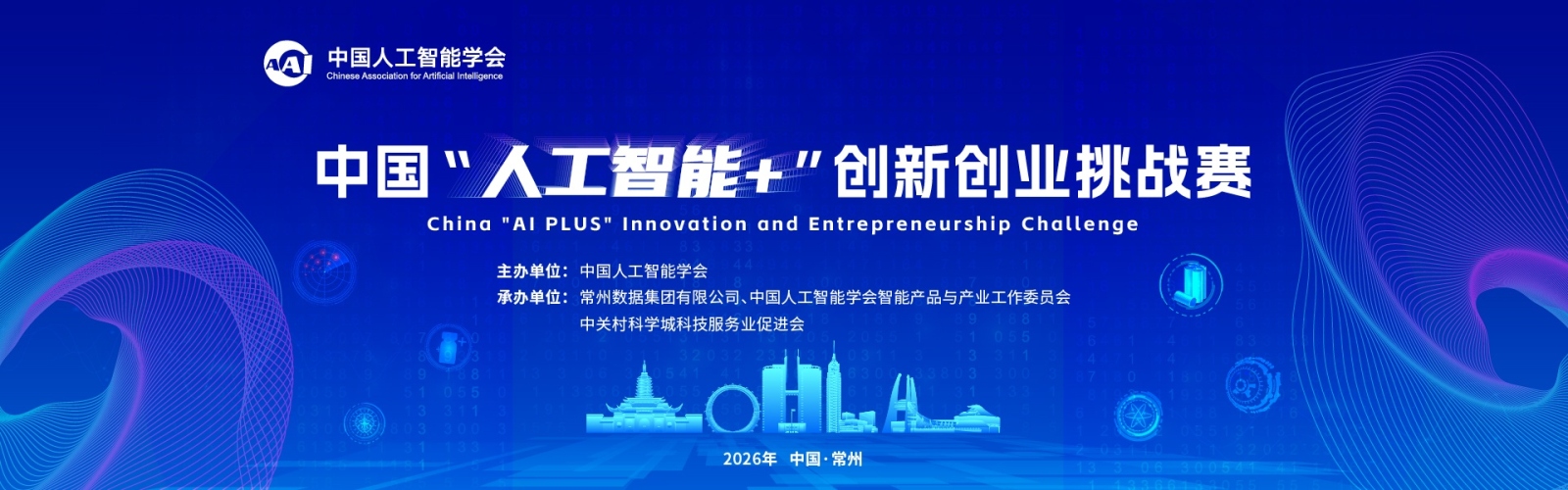
Amidst the nation - s drive to cultivate new quality productive forces and implement the "AI+" action plan, a major AI event that brings together cutting-edge expertise and links to trillion-yuan industrial resources has officially begun. In April 2026, the "2026 China 'AI+' Innovation and Entrepreneurship Challenge," hosted by the Chinese Association for Artificial Intelligence (CAAI) and co-organized by several authoritative institutions, officially issued a global call for participants. Leveraging the strong industrial foundation and policy resources of the Yangtze River Delta - s key industrial technology innovation hub and national innovative cities, the competition offers participants comprehensive, high-caliber support across funding, application scenarios, computing power, and data.
As a core force driving deep integration of AI and the real economy, CAAI has successfully held multiple high-level competitions in recent years, developing a unique operational philosophy of "using competitions to fuel research, evaluation, standard-setting, and industrial incubation." These events have attracted nearly 8,000 innovative teams to date.
CAAI Chairman and Academician Dai Qionghai emphasized that the ultimate mission of artificial intelligence is to nurture creative talent. This challenge is not only a flagship annual event for CAAI but will also tap into the association - s extensive expert think tank to provide participating teams with one-on-one advisory group mentorship, helping entrepreneurs tackle strategic planning and operational challenges.
Precision Empowerment: A Yangtze River Delta Solution Targeting Core Entrepreneurial Pain Points
Against the backdrop of numerous AI competitions emerging nationwide, entrepreneurs are most concerned not only with recognition but also with tangible resources. The 2026 China "AI+" Innovation and Entrepreneurship Challenge, drawing on the robust industrial ecosystem and policy framework of a core Yangtze River Delta city, offers tailored, full-lifecycle support policies that directly address the four major pain points commonly faced by AI startups: capital shortages, difficulty finding application scenarios, high computing costs, and scarce data.
Add:No. 10, Xitucheng Road, Haidian District, Beijing Postal Code:100876
Copyright © 2026 Chinese Association for Artificial Intelligence 互联网ICP备案:京ICP备06029423号-1  京公网安备11010802045678号
Technical support:中科服 010-83869879
【本网站翻译内容来源于AI】