 Office System

CAAI Newsroom
AI-Powered Smart Logistics Sharing Session Explores New Pathways for Industry Growth
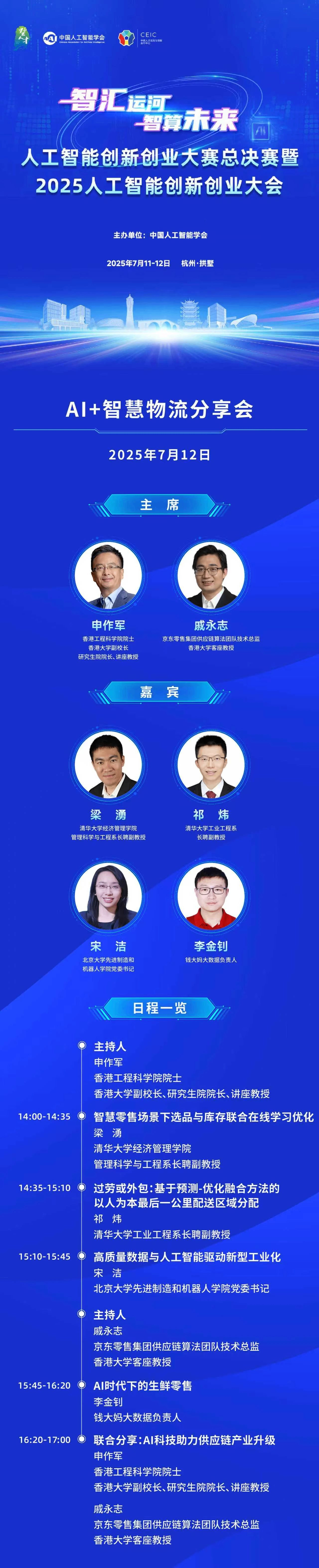
Against the backdrop of a booming digital economy, artificial intelligence is profoundly reshaping the operational logic and development paths of the logistics industry. On the afternoon of July 12, as a key component of the - Wisdom Canal · Computing for the Future, series, the - AI+ Smart Logistics, sharing session will be held in Gongshu District, Hangzhou. The event aims to build a platform for integrating industry, academia, research, and application, focusing on innovative practices of AI technologies in core scenarios such as supply chain optimization, intelligent decision-making, and logistics efficiency improvement, thereby driving the logistics industry toward a data-driven, intelligently coordinated new stage.
Focusing on Efficiency Leap: AI Empowers End-to-End Logistics Transformation
The logistics industry currently faces multiple challenges, including increased demand volatility, rising operational complexity, and higher sustainability requirements. Leveraging its unique strengths in data analysis, pattern recognition, and decision optimization, AI is becoming a key force in breaking through industry bottlenecks - from intelligent warehouse sorting and dynamic transport route planning to precise demand forecasting and collaborative inventory management. AI technologies span the entire supply chain lifecycle, helping enterprises reduce costs, improve efficiency, and enhance user experience.
This sharing session will closely follow the pulse of industry development, exploring in depth how AI drives logistics systems from "experience-driven" to "algorithm-driven" approaches. Key areas of focus include: how intelligent decision-making optimization enables optimal resource allocation under complex constraints; how the integration of multi-source heterogeneous data enhances supply chain transparency and responsiveness to unlock data value; how to build human-machine collaborative innovation for a new delivery model that balances automation technology with human-centered considerations; and how algorithm optimization can reduce the carbon footprint to achieve green logistics practices that realize both economic benefits and environmental responsibility.
Add:No. 10, Xitucheng Road, Haidian District, Beijing Postal Code:100876
Copyright © 2026 Chinese Association for Artificial Intelligence 互联网ICP备案:京ICP备06029423号-1  京公网安备11010802045678号
Technical support:中科服 010-83869879
【本网站翻译内容来源于AI】