 Office System

CAAI Newsroom
CAAI Campus Tour: Successful Session at China Jiliang University
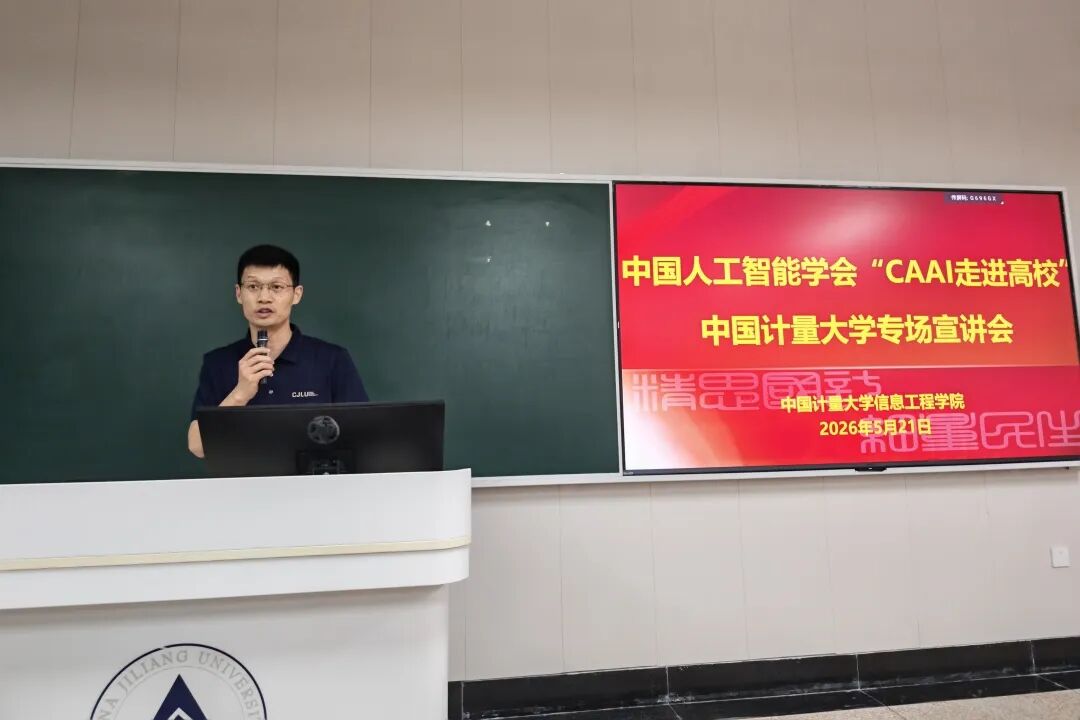
On the afternoon of May 21, the China Artificial Intelligence Society (CAAI) successfully held its "CAAI Campus Tour" special session at China Jiliang University. The event was organized by the university's School of Information Engineering. Attendees included Chen Wenbai, Deputy Secretary-General of CAAI and professor at the School of Automation, Beijing Information Science and Technology University; Liu Yanna, secretary of the Science and Technology Exchange and International Cooperation Office; Chen Guang, secretary of the Awards and Achievements Office; Li Guochao, secretary of the External Liaison Office; Hao Yifan, director of the editorial office of CAAI Transactions on Intelligence Technology; and Han Yanan, a member of the same editorial office. Chen Baiping, associate professor at the School of Computer Science and Technology, Hangzhou Dianzi University, was also invited as a special guest to share his experience. From China Jiliang University, Zhang Mingming, deputy director of the Office of Scientific Research; Zhao Jianwei, associate dean for research of the School of Information Engineering; Jing Xufeng, associate dean for academic affairs; along with faculty and student representatives from the Department of Computer Science and the Department of Artificial Intelligence, participated in the session, which was presided over by Zhao Jianwei.
At the start of the session, Zhang Mingming delivered a welcome address, expressing warm appreciation to the CAAI experts. He noted that as the highest-level academic society in China's AI field, CAAI plays an irreplaceable role in academic leadership, talent cultivation, and scientific awards. He particularly emphasized that the "Wu Wenjun AI Science & Technology Award" is regarded as the highest honor in China's intelligent science and technology sector, and that this special event was a significant endorsement of China Jiliang University's work in AI discipline development. He encouraged faculty and students to seize the opportunity to fully understand CAAI's academic resources and award system, actively benchmark against standards, and strive for major breakthroughs in future award applications.
Following that, Deputy Secretary-General Chen Wenbai systematically introduced the overall profile of CAAI. He provided an in-depth explanation of the "Wu Wenjun AI Science & Technology Award" and the application procedures for science and technology achievement awards, detailing the award's background, categories, scope, nomination methods, and review process, with special emphasis on the core logic behind application work. He pointed out that applicant teams must accurately grasp the essential differences among the three types of achievement awards: the Natural Science Award focuses on scientific discoveries and theoretical innovation, requiring profound academic value; the Technology Invention Award focuses on "from 0 to 1" breakthroughs in core technologies, emphasizing originality and irreplaceability; and the Science and Technology Progress Award places high importance on practical application, economic and social benefits, and market penetration. When preparing application materials, he advised aligning with the award's positioning and review perspective, strategically restructuring materials to highlight core strengths. He also introduced CAAI's science and technology achievement evaluation services, the CAAI Incentive Program, and academic funding and computing power support plans, providing clear pathways and practical guidance for attending faculty and students to access research resources, conduct achievement appraisals, and promote technology transfer.
Add:No. 10, Xitucheng Road, Haidian District, Beijing Postal Code:100876
Copyright © 2026 Chinese Association for Artificial Intelligence 互联网ICP备案:京ICP备06029423号-1  京公网安备11010802045678号
Technical support:中科服 010-83869879
【本网站翻译内容来源于AI】