 Office System

CAAI Newsroom
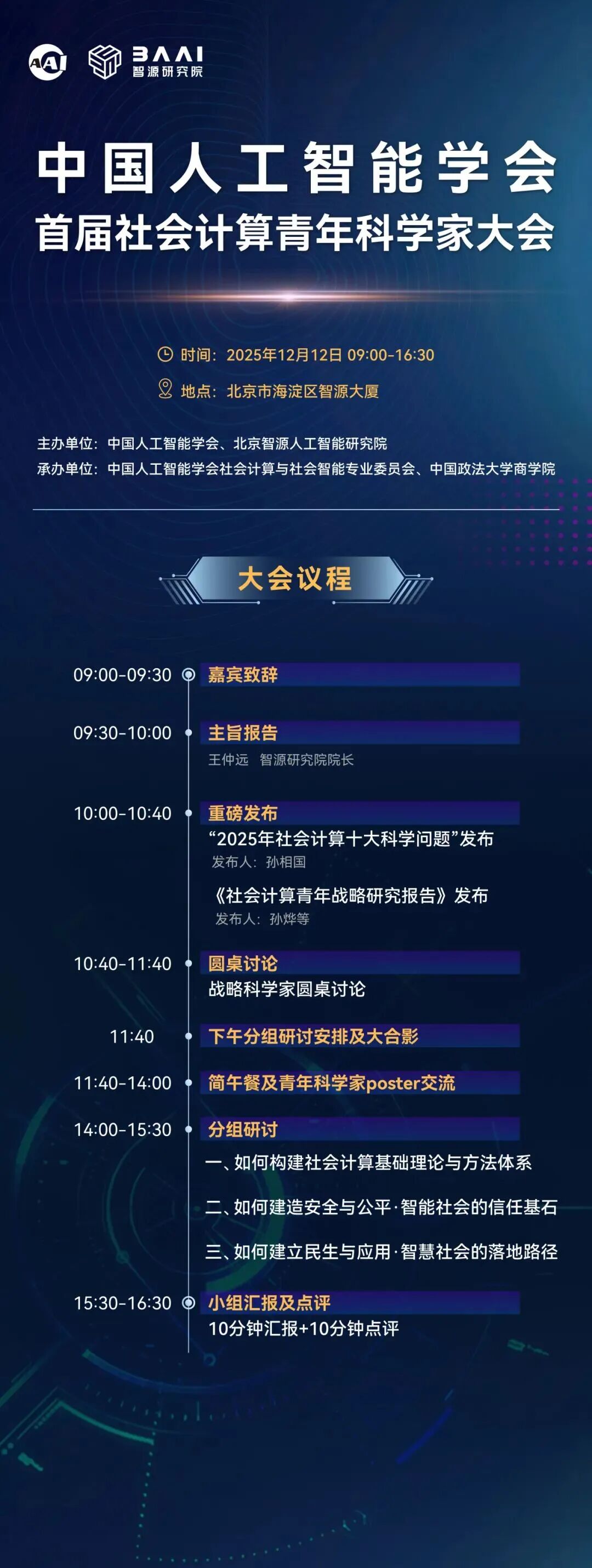
CAAI Social Computing Young Scientist Conference (CAAI SCYS 2025) to Be Held in Beijing
Amidst a new wave of technological revolution and industrial transformation, artificial intelligence has become a core driver for reshaping research paradigms and fostering innovation in social governance. The State Council's "Opinions on Deeply Implementing the AI Plus Action" explicitly calls for "innovative research methods in philosophy and social sciences," "building a new model for cultivating leading talents beyond conventional approaches," and "giving young researchers more room to excel," encouraging scientists and researchers to boldly explore uncharted territories in AI.
Against this backdrop, social computing - as a cutting-edge interdisciplinary field bridging computational intelligence and the social sciences - is facing unprecedented opportunities for growth. Cultivating young strategic scientists with forward-looking vision and strategic resolve is of great significance for advancing disciplinary innovation and breakthrough and for supporting China's medium- and long-term strategic needs. To this end, on December 12, 2025, the inaugural "Social Computing Young Scientist Conference" will be held at the Beijing Academy of Artificial Intelligence (Zhiyuan Tower). The conference will bring together leading young talents from interdisciplinary fields related to social computing, focus on ten key scientific questions in the domain, and conduct in-depth discussions on the core elements of a "resilient intelligent society" and the development of talent systems.
Date and time: December 12, 2025, 09:00 - 16:30
Venue: Zhiyuan Tower, Haidian District, Beijing
Beijing Academy of Artificial Intelligence
CAAI Special Committee on Social Computing and Social Intelligence
Interdisciplinary dialogue among young scholars in computational science and social sciences
This dialogue will not only help computational science researchers expand the boundaries of social scenarios and imbue technology with humanistic warmth, but also equip social science researchers with quantitative tools to enhance research accuracy and decision-making empowerment, thus unlocking innovative potential and broadening academic horizons in both directions.
Add:No. 10, Xitucheng Road, Haidian District, Beijing Postal Code:100876
Copyright © 2026 Chinese Association for Artificial Intelligence 互联网ICP备案:京ICP备06029423号-1  京公网安备11010802045678号
Technical support:中科服 010-83869879
【本网站翻译内容来源于AI】