 Office System

CAAI Newsroom
CAAI National Conference on Big Data and Social ComputingSuccessfully Held

The 6th CAAI National Big Data and Social Computing Conference (BDSC2021) was successfully held in Chongqing, Shanghai and Beijing from December 9th to 11th, 2021, hosted by the Chinese Association for Artificial Intelligence and organized by CAAI Social Computing and Social Intelligence Special Committee and Chongqing Technology and Business University, in an "online" and "offline" manner.

Group photo of Beijing Branch

Group photo of Chongqing Branch
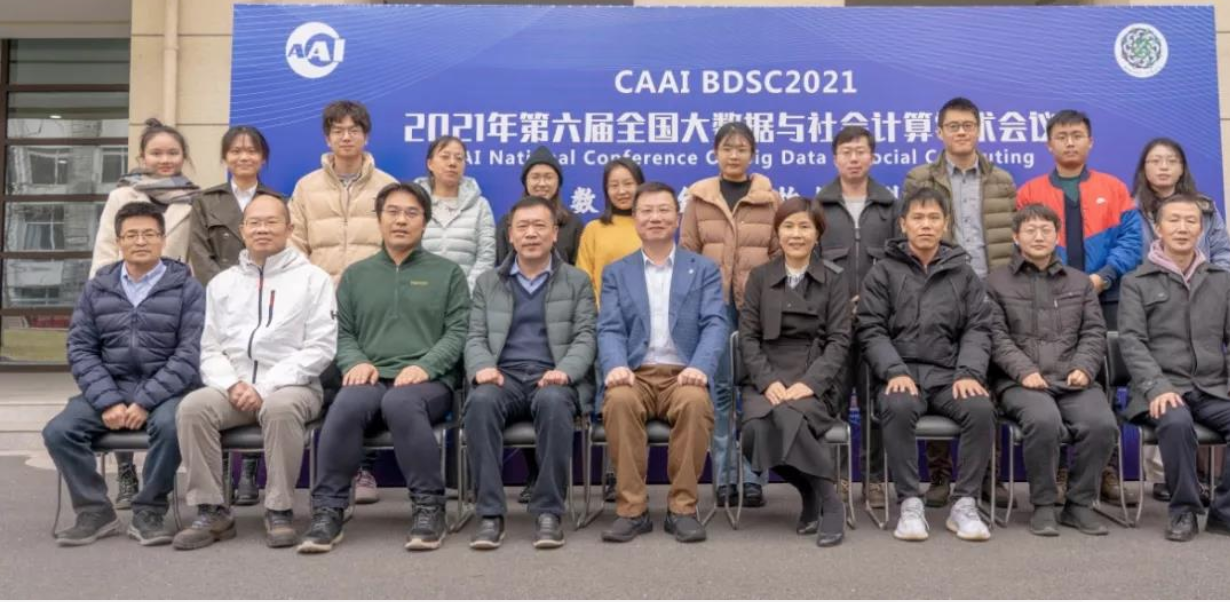
Group photo of Shanghai Branch
Conference Opening Ceremony
BDSC2021 opened successfully in the morning of December 9. At the opening ceremony, Prof. Wang Guoyin, Vice President of CAAI, Co-Chair of BDSC2021, and Vice President of Chongqing University of Posts and Telecommunications (CUPT), delivered a speech on behalf of the CAAI, expressing congratulations to the successful convening of the 6th National Conference on Big Data and Social Computing in 2021 and wishing the conference have a complete success. Professor Sun Fangcheng, co-chair of BDSC2021 and president of Chongqing Technology and Business University, extended a warm welcome to the scholars and briefly introduced the situation of Chongqing Technology and Business University and the School of Public Administration and the School of Artificial Intelligence, which specifically hosted the conference. He looked forward to a full collision of wisdom and innovative thinking, and to take this opportunity to enhance consensus and cooperation for a better future of human society. Prof. Wang Xiaofan, Vice President of Shanghai University, attended the opening ceremony of the Shanghai Branch and delivered a speech offline. Prof. Wang Xiaofan expressed his sincere congratulations to the successful convening of the 6th National CAAI Conference on Big Data and Social Computing in 2021 and wishing the conference have a complete success. He also wished CAAI Social Computing and Social Intelligence Special Committee could make more contributions and produce more high-quality results in the cross-disciplinary field in the future.
Prof. Meng Xiaofeng, Director of CAAI Social Computing and Social Intelligence Committee and Professor of Renmin University of China, delivered a speech. On behalf of the committee, Prof. Meng expressed his gratitude to all the leaders, experts, scholars and students who attended the opening ceremony, and expressed his heartfelt thanks to the organizers, co-organizers and preparatory organizer of the conference for their hard work. Prof. Meng introduced the purpose, objectives and characteristics of the committee and expected more experts and scholars to join the committee and make continuous efforts to build an academic community of "benevolence, faith and affection".
Professor Yu Jianxing, President of Institute of Social Governance of Zhejiang University and President of ZheJiang University of Technology and Business, delivered a speech on behalf of the organizers of CAAI 7th National Big Data and Social Computing Conference (BDSC2022), introducing the preparedness plan and preparation in terms of venue, topic setting and brief agenda. Meanwhile, Prof. Yu also talked about his views and opinions on digital transformation and planned to organize field trips for experts and scholars to visit the actual application scenes of digitalization in Hangzhou, Zhejiang Province during the conference.
Report on the organization of the Conference
Huang Kuang-Shi, Chairman of the BDSC2021 Program Committee, reported on the collection and inclusion of papers in the conference. The conference called for papers for the first time In total, 96 academic papers were collected, 60 manuscripts in Chinese and 36 in English. A total of 74 universities and research institutions participated in the submission, among which 14 universities submitted more than 3 manuscripts. The papers covered 14 topics, including data science and algorithms, complex networks, management science, organizational behavior, financial technology and financial markets, spatial computing and urban science, computational society, computational communication, digital government and public security, computational medicine and health management, computational psychology, computational education and bibliometrics. The conference invited 93 experts to review the submitted papers, and the total number of reviews was 226. After anonymous evaluation, the conference program committee decided to include 77 papers. After consultation with the journal editorial board, discussion with the presidium of the program committee, and author's consent, 37 papers were recommended to related journals.
Professor Zhang Hui of Tsinghua University, Deputy Director of CAAI Social Computing and Social Intelligence Committee and Chairman of Social Computing Competition, gave a report on the work of the 1st Social Computing Competition on behalf of the Competition Evaluation Committee, introducing the theme, purpose and significance of the competition, the organization and selection process of the competition; he highly praised the research results of the participating teams and introduced the important roles of the research results in helping Beijing 2022 Winter Olympic Games, achieving the overall goal of "building a vaccine barrier and time-divisional control".
On behalf of the committee, Prof. Meng Xiaofeng, Director of CAAI Social Computing and Social Intelligence Committee, released the Report on the “Development of Social Computing in China”, which was completed by a working group organized by CAAI Social Computing and Social Intelligence Committee on the basis of a strategic workshop in Luoyang, and polished through many rounds such as the Xiangshan Workshop. The report analyzes the development history of social computing, summarizes the development status of social computing at home and abroad, reveals the advantages of social computing development in China, and indicates the development trend of social computing. Director Meng Xiaofeng pointed out that CAAI Social Computing and Social Intelligence Committee will devote itself to identifying new materials, discovering new problems, exploring new methods, contributing to the change of research paradigm, establishing a model of cross-discipline, strengthening the cultivation of social computing talents, establishing an academic community with benevolence, trust and affection, and promoting the rapid development of social computing in the future.
Development of the Special Committee
In order to further expand the scale and influence of the committee, a certificate awarding ceremony for newly elected members of the committee was also held during the meeting. It was carried out simultaneously offline and online. Vice Chairman Wang Guoyin, Director Meng Xiaofeng and Deputy Director Qi Jiayin delivered membership certificates offline in Chongqing, Beijing, Shanghai and also online to the new members respectively.
Professor Le Yang of Shenzhen University, a member of CAAI Social Computing and Social Intelligence Committee, made a report on behalf of the Spatial Social Computing Group, introducing the preparation and establishment process of the group as well as the distribution of the executive members of the group, and depicting in detail the goals, vision and future work plan. As the first professional group of the committee, the group will live up to the expectations and try to explore an effective path for the rapid and high-quality development of the group under the leadership of the Committee.
Conference Reports
In the report session, Prof. Fan Weicheng, Academician of Chinese Academy of Engineering, Tsinghua University, Prof. Wang Xiaofan, Vice President of Shanghai University, Prof. You Xiaohu of Southeast University, and He Dan, Director of China Population and Development Research Center, were invited to give keynote reports. With the theme of "Safety Science and Education Progress", Academician Fan firstly introduced the important role of science and technology in the preparation, holding and operation of the Winter Olympic Games, and took the core technology of scientific training for Winter Olympic projects, intelligent, refined, all-round, efficient and collaborative management, safety and command as the breakthrough point to significantly improve China's Winter Olympic sports performance, to ensure the wonderful, extraordinary and excellent present of Winter Olympics. Next, Academician Fan introduced the importance, necessity and urgency of setting up the first-level discipline of national security, as well as the development focus and future outlook of national security discipline.
Focusing on the theme of “Analysis and Empirical Study of Web Propagation Cascade Dynamics”, Prof. Wang Xiaofan introduced in detail the criteria for judging the diffusivity characteristics of cascade propagation, the difference between the propagation characteristics of untrue and true information, and the node characteristics of highly reputable users, and analyzed the importance and value of analyzing the network cascade propagation characteristics and node influence based on large-scale network propagation data.
Prof. You Xiaohu from Southeast University introduced the current 6G development situation and vision, and proposed the 6G network development paradigm. Based on this paradigm, he focused on the analysis of 6G key performance index requirements, the potential overall architecture and key supporting technologies of 6G network, and summarized the recent milestones achieved by Zijinshan Laboratory in 6G.
Director He Dan of China Population and Development Research Center introduced the background of population aging in the construction of smart society, analyzed the impact of technological progress on population development, studied the development of digital technology and the evolution of human society, and focused on the construction of smart society in the era of digital civilization.
Special Reports
From the afternoon of December 9 to December 11, eight thematic forums were held on social computing and communication, artificial intelligence social experiments, social computing and population development, social computing and management, social computing and governance of complex social systems, social computing and psychology, social computing and open knowledge graphs, and spatial social computing. There were also exciting activities such as Social Computing Rising Stars Forum and Social Computing Competition Final.
Thesis Presentations
A special arrangement was also made for thesis presentation during the conference. A total of 68 papers were submitted, and e-posters and short videos of these papers were broadcasted online during the conference and exclusively in the Shanghai session. The authors of 28 papers were invited to make online presentations.
Frontiers Workshop
On December 11, a frontier workshop was held online with the theme of "Causality Discovery in Social Systems". The workshop was chaired by Professor Zhang Jiang from Beijing Normal University, with Professor Cai Ruichu from Guangdong University of Technology, Researcher Huang Kuangshi from National Population and Development Research Center, Researcher Chen Wei from Guangdong University of Technology, and Dr. Li Fengzhi from Chinese Academy of Sciences as the main lecturers. The workshop mainly introduced the relevant basic knowledge related to causal discovery. Starting from the models and assumptions of causal graph construction, it introduced the three major types of causal discovery methods, namely constraint-based methods, causal function model-based methods and hybrid methods;and discussed the applications of causal graphs in the fields of social surveys, social networks and population change analysis. The workhop also explained how to programmatically implement typical causal discovery methods using the python language, as well as the use of Tetrad software to achieve automatic causal graph construction from data.
The conference was successfully held both online and offline. This important attempt not only met the requirements of pandemic prevention and control, but also ensured the conference to carry out as planned. CAAI Social Computing and Social Intelligence Committee will continue to work hard and look forward to more experts and scholars to join in the future It will also dedicate to provide academic conferences with higher level and higher quality for everyone.
This article is contributed by CAAI Social Computing and Social Intelligence Committee
Add:No. 10, Xitucheng Road, Haidian District, Beijing Postal Code:100876
Copyright © 2026 Chinese Association for Artificial Intelligence 互联网ICP备案:京ICP备06029423号-1  京公网安备11010802045678号
Technical support:中科服 010-83869879
【本网站翻译内容来源于AI】